
Rooftop, Courtyard & Pavement Seating for Bars & Restaurants
Urban outdoor trading is a different game to a big pub garden. Rooftops, courtyards and pavements come with tight footprints, awkward access, wind exposure, neighbour sensitivity and the constant pressure to keep service moving. The furniture you choose has to earn its place: it must help you run the space smoothly, keep guests comfortable, and support a more premium experience — without becoming a daily reset nightmare.
This page looks at rooftop seating, courtyard seating and pavement seating from an operator’s point of view: how to plan capacity in narrow spaces, manage stability on slopes and drains, protect service routes, store furniture when there’s no back-of-house, and choose materials that cope with city grime, spills and frequent wipe-downs. For the wider range context, start at our Outdoor commercial furniture hub.
Why small-footprint outdoor spaces fail (and how furniture fixes it)
Most problems in compact outdoor areas come down to one thing: the space can’t breathe. Staff can’t pass easily, guests feel crowded, tables wobble on uneven ground, and furniture drifts into routes. When the space is full, every little irritation multiplies — and that’s when service slows, breakages happen, and the terrace starts to feel stressful instead of special.
Furniture can’t create extra square metres, but it can reduce friction. The right mix of table sizes, stable bases, and space-saving chairs helps you protect the routes that matter and keeps the layout consistent throughout service. That consistency is what makes a small rooftop or pavement area feel professional rather than improvised.
Capacity planning for narrow rooftops, courtyards and pavements
In tight footprints, chasing maximum covers can backfire. A layout that “fits” on a plan may not work in reality once you add doors, thresholds, queue behaviour and staff carrying trays. The practical aim is maximum usable covers — the number of guests you can serve well, repeatedly, without constant re-laying.
Start by identifying pinch points: access doors, gates, steps, lift lobbies, and anywhere staff need to turn with trays. Then build the seating plan around those constraints. If the space only works when guests tuck chairs in perfectly, it won’t work on a busy Friday.
For operators used to bigger outdoor spaces, it can be helpful to compare the differences in approach. Our Pub garden & terrace furniture page looks at larger, more flexible garden layouts — whereas rooftops and pavements are usually about tighter control and faster reset.
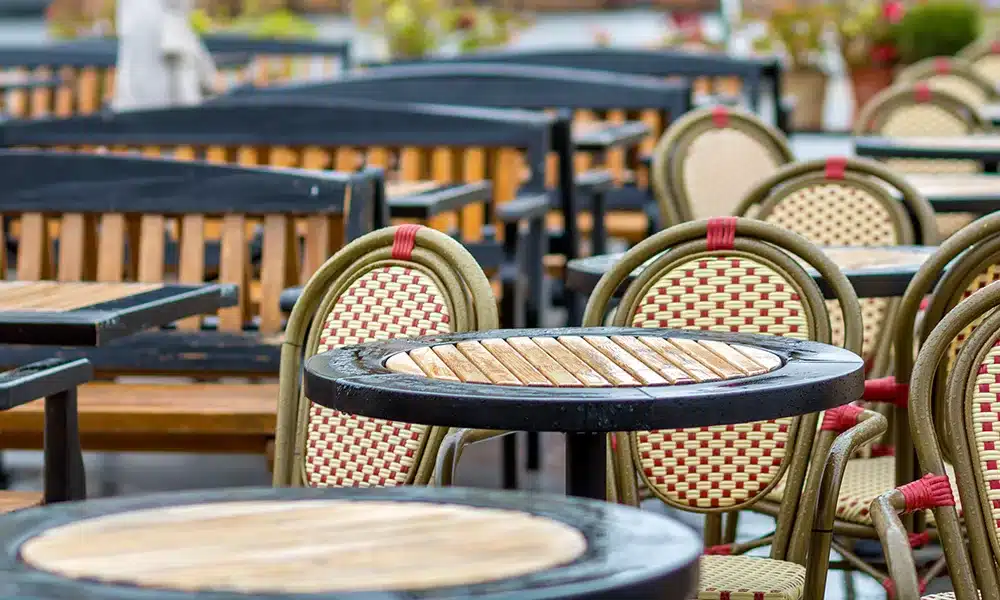
Service routes on a rooftop terrace: planning for tray runs
“How do we plan service routes on a rooftop terrace?” is often the deciding factor between a terrace that prints money and one that drains labour.
In compact rooftop spaces, staff routes usually need to be direct and predictable: from the access point (stairs/lift door) to the highest-demand tables, and back again without weaving through chair backs. If staff have to squeeze behind seated guests, you’ll see more spills and slower clearing — which reduces your ability to turn tables and maintain the premium feel you’re aiming for.
A good layout also anticipates clearing routes. It’s not just about delivering drinks; it’s about removing glassware quickly and safely when the terrace is full. Keeping at least one reliable “clearing lane” is often more valuable than squeezing in an extra two-top.
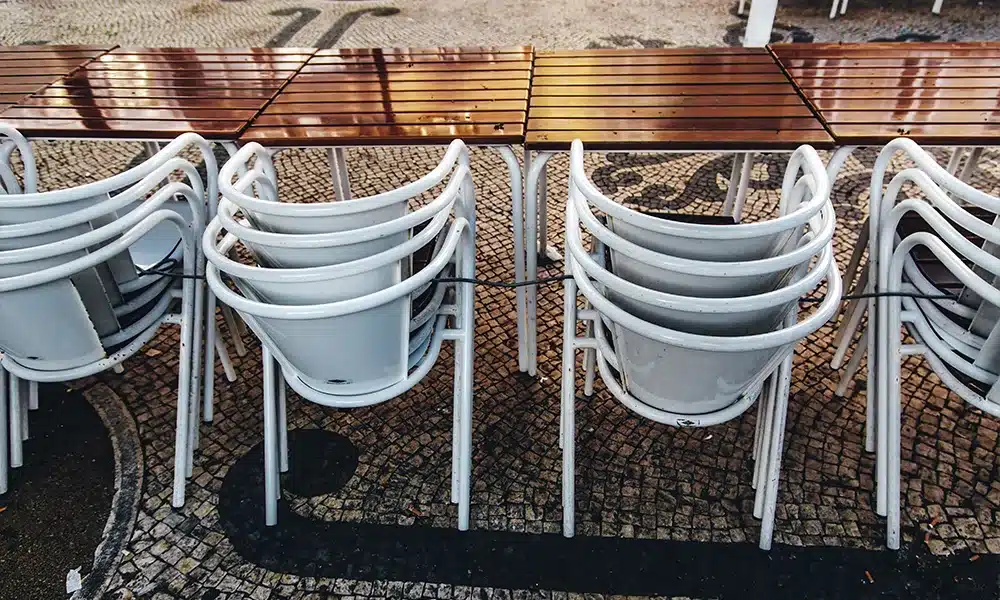
Stability in wind: base weight, low centre of gravity and anti-tip thinking
Rooftops behave like wind tunnels. Even in central London, wind can be unpredictable once you’re above street level, and gusts can make lightweight furniture unsafe. The practical answer isn’t “heaviest possible everything” — it’s the right weight in the right place, with sensible proportions.
Tables are the key risk point. A tall poseur setup with a light base can become unstable quickly, especially when guests lean or when umbrellas are involved. Prioritise low centre of gravity, appropriate base weight for the tabletop size, and a setup that still feels stable when someone rests their elbow on the edge.
If you’re frequently asking “how do we stop terrace furniture blowing over?”, it’s a sign that furniture needs to be specified around wind reality, not just aesthetics. The safest terraces are the ones where stability has been designed in, not managed day-to-day by staff moving pieces around.
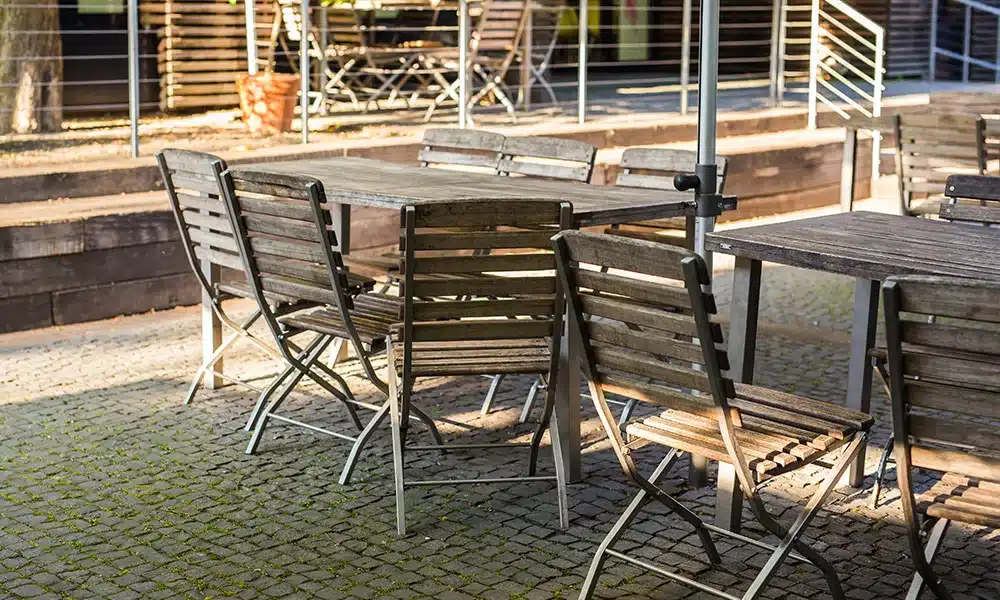
Slopes, drains, pavers and temporary decking: wobble management in the real world
Courtyards and pavements rarely give you a perfect surface. You’ll have gentle falls for drainage, uneven pavers, inspection covers, thresholds and occasionally temporary decking solutions. In those conditions, wobble becomes the number-one guest complaint — and it’s one that staff can’t “service their way out of”.
The best approach is to avoid creating lots of unique table situations. Standardise table sizes and base types where possible, then position them deliberately so you’re not placing your most sensitive setups directly over the worst surface points. When the space is tight, it’s worth planning a few “known stable” anchor positions and building the rest around them.
Zoning: drinks-led versus dining-led covers (and why it changes table choices)
A rooftop bar and a courtyard restaurant can share the same footprint size, but behave very differently. Drinks-led trade often wants faster access, more standing moments, and shorter, repeated rounds. Dining-led trade needs more table comfort, more stability, and a calmer flow that supports longer stays.
In small spaces, zoning doesn’t have to be rigid. It can be as simple as table selection and placement: slightly smaller tables nearer the bar/service points for drinks-led use, and more stable, comfortable dining setups where you can support food service without constant interruptions.
This is also where poseur tables can have a role — but only where they’re stable and positioned intelligently. A few well-placed poseurs can lift revenue per square metre in drinks-led zones, while keeping standard-height dining tables where dwell time and comfort matter more.
Storage and reset strategy when there’s no back-of-house
Pavement and rooftop areas often have one big operational challenge: where does it all go? If you don’t have storage, your furniture choice has to do the work for you.
Stackability and easy movement become more than convenience — they become the only way to close down quickly, protect the space in bad weather, and comply with practical site rules (especially for pavement trading). Chairs that stack neatly and tables that can be moved without a wrestling match make the difference between a clean close-down and a team staying late to “fight the furniture”.
Before you order anything, decide where stacks will live and how they’ll be moved. If you can’t visualise the close-down routine, you’re not ready to specify.
Neighbour and noise sensitivity: reducing scrape and clatter without overthinking it
Noise complaints in city venues are often driven by the small, repetitive sounds: chair legs scraping, tables being dragged, and glassware clinking on unstable surfaces. You don’t need an acoustic thesis to improve this — you need a practical furniture plan.
Stable tables reduce clatter and spills. Layouts that give staff clean routes reduce the number of chair movements during service. And furniture that feels solid tends to be handled more confidently, which reduces the “constant shifting” that creates noise.
In courtyards and enclosed urban spaces, these small changes matter because sound reflects. A terrace that “feels calmer” is often one that simply has fewer furniture-related irritations.
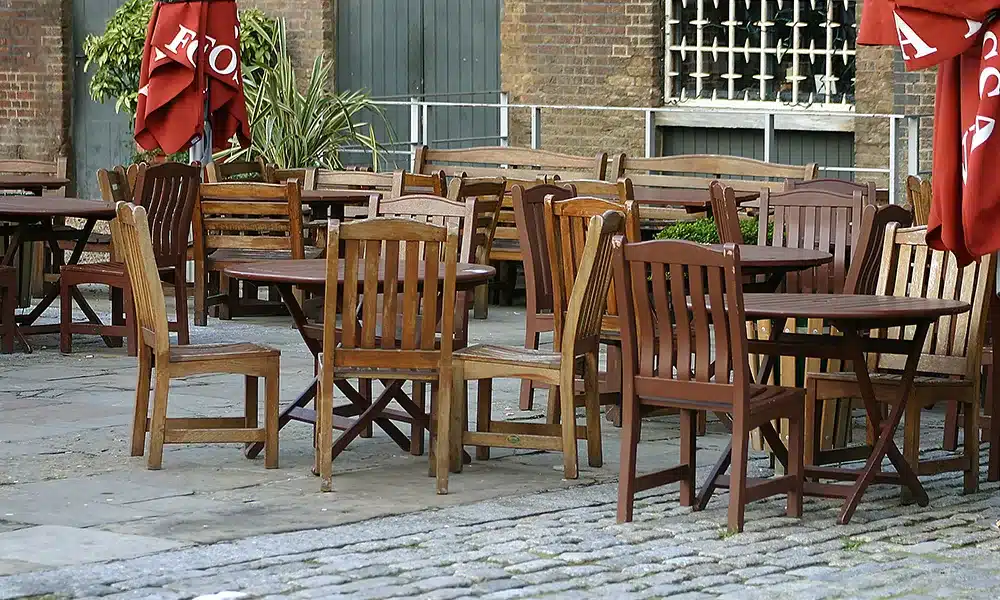
Shade and shelter strategy: parasols and compact cover planning
Shade is a revenue tool. Guests stay longer when they’re comfortable, especially on rooftops where sun exposure can be intense. But parasols and bases need to be planned with circulation and stability in mind — not treated as last-minute add-ons.
If you’re using parasols, make sure table spacing allows them without turning routes into an obstacle course. Consider how bases affect trip risk in tight spaces, and avoid placing parasols where wind exposure is highest unless you have a genuinely stable solution. In compact footprints, fewer well-placed shade points usually work better than many small ones competing for space.
Materials for UK rooftops and courtyards: city grime, spills, UV and wipe-downs
Outdoor furniture in urban settings gets dirtier than operators expect: pollution film, pollen, bird mess, sticky drink residue, and the inevitable spills of food and sauce. That’s why material choice should be driven by how you’ll clean the space on a busy week, not how it looks on a photoshoot day.
Choose finishes that tolerate frequent wipe-downs and don’t punish you for strong cleaning products. Avoid surfaces that trap grime in grooves or textures if you know your team needs speed. And be realistic about colour: very light finishes can look premium, but they often demand a tighter cleaning routine to stay that way in city environments.
Fixed versus loose seating in tight outdoor footprints
Fixed seating can be a powerful space-saver in small rooftops and courtyards, particularly along edges and boundaries. It keeps circulation clearer, reduces chair drift, and can make a compact space feel more intentional and premium.
Loose furniture gives flexibility, but in tight footprints it also creates daily unpredictability — tables get pulled together, chairs migrate, and routes disappear. Many successful city terraces use a hybrid: fixed seating on the perimeter to “draw the room”, with loose tables and chairs in the centre for adaptable covers.
If you’re considering fixed seating as part of a premium layout, our Outdoor booth & banquette seating page explains how outdoor banquettes change flow, maintenance and capacity compared with fully loose setups.
Premiumisation: how furniture supports higher spend per head
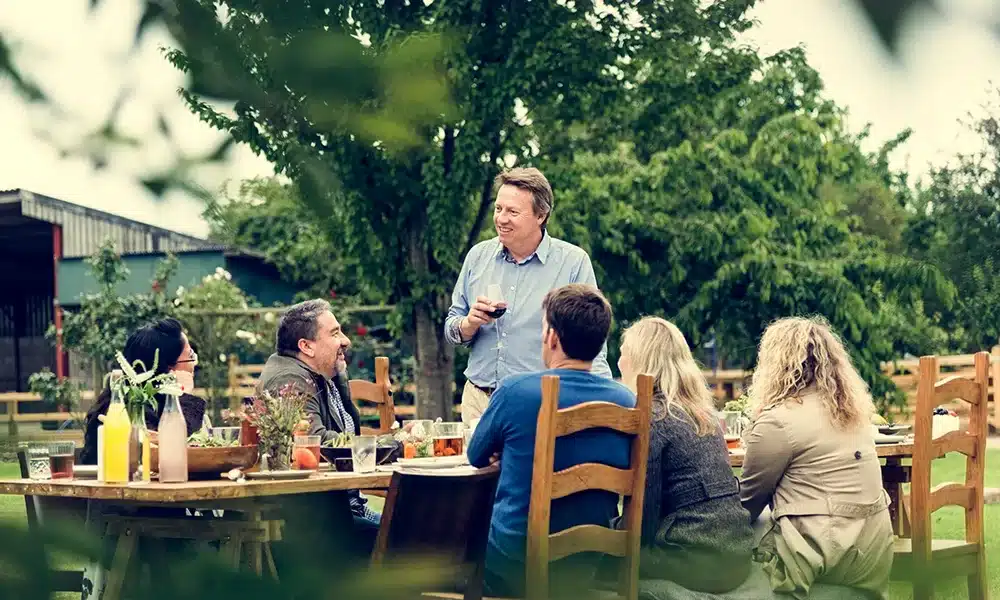
Rooftops and courtyards often trade on experience. Guests pay more because the setting feels special. Furniture plays a bigger role here than it does in a large beer garden: when the footprint is compact, every table and chair is close-up and highly visible.
Premiumisation doesn’t mean “fancy furniture”. It means furniture that feels deliberate: stable tables, comfortable seating, consistent finishes, and a layout that supports relaxed service rather than constant shuffling. When the terrace looks controlled and comfortable, guests tend to stay, order again, and come back.
Quick contrast: indoor vs outdoor requirements
When you need a deeper selection guide
This page is about planning and operational realities. If you’re at the point of choosing the actual mix of table sizes and chair types, our Outdoor tables & chairs for pubs & cafés guide goes deeper into selection considerations such as stability, stackability and day-to-day usability across different outdoor trading styles.
Talk to us about your rooftop, courtyard or pavement layout
If you’re adding outdoor covers in a tight footprint, upgrading a city-centre terrace, or trying to make a rooftop run more smoothly in peak service, we can help you plan a practical furniture mix that supports stability, circulation and higher-spend trading.
Start at Outdoor commercial furniture and share your dimensions, access points and cover targets for a clear, project-ready recommendation.
- sales@hcfcontract.co.uk
- 01708 331757