UK Guide To Outdoor Tables & Chairs for Pubs & Cafés

Outdoor trading can transform a venue’s turnover — but only if the furniture is built and planned for real hospitality use. In pub gardens, terraces and pavement areas, your tables and chairs deal with more than customers: they deal with wind, uneven paving, sudden rain, strong sun, constant dragging, and aggressive end-of-day clean-downs. Domestic garden sets rarely survive that combination for long, and indoor furniture simply isn’t designed for it.

This guide covers how to choose outdoor tables and chairs that work for pubs and cafés: stability on imperfect surfaces, weighted bases and wind exposure, layout planning for smooth service lanes, materials that cope with UV and cleaning chemicals, stackability and storage, and the everyday routines that make outdoor areas either easy to run or a constant headache. For the full outdoor range context, start at our Outdoor commercial furniture hub.

Why commercial outdoor tables and chairs are a different category

Outdoor hospitality furniture lives a harder life than most operators expect. You’re not just choosing “weather resistant” — you’re choosing furniture that can be moved repeatedly, cleaned quickly, and still look presentable after a long season of use. In other words, contract outdoor furniture isn’t defined only by materials; it’s defined by how it behaves when a team is resetting a terrace at pace.

The biggest difference between commercial and domestic sets is stability and serviceability. In a pub garden, a wobbly table doesn’t just annoy a guest — it slows your team down, increases spill risk, and creates a stream of small complaints that undermine the overall experience. A chair that can’t be stacked, cleaned quickly, or replaced easily becomes a friction point in daily operations.

Start with the site: wind, surface and exposure

Before you pick styles, get clear on your conditions. Outdoor spaces tend to fall into three practical “risk” types:

A sheltered courtyard can tolerate lighter furniture and a wider aesthetic range. A terrace with partial cover still gets wind-driven rain and temperature swings. A pavement frontage can be the harshest of all: pedestrians, licensing boundaries, high visibility, and gusts that can move lightweight pieces.

The key decision point: specify for the worst day, not the best day. If your tables and chairs are stable and practical in wind and rain, they’ll feel effortless when the sun’s out.

Stability on uneven surfaces: the wobble problem

Uneven patios, old paving and threshold transitions are normal in hospitality — especially for pubs with beer gardens that have evolved over decades. That’s why “outdoor tables that won’t wobble on patios” is one of the most valuable outcomes you can buy.

A stable outdoor table comes from three things working together: a base that resists rocking, a top size that suits the base, and feet that can tolerate slight level changes without turning the table into a seesaw. Even small wobble issues become big when you multiply them across 20 tables.

If your surface is imperfect, it’s usually better to choose fewer table sizes and a more robust base approach than to try to offer every possible layout. Consistency reduces the chances of “that one table” always being the problem table.

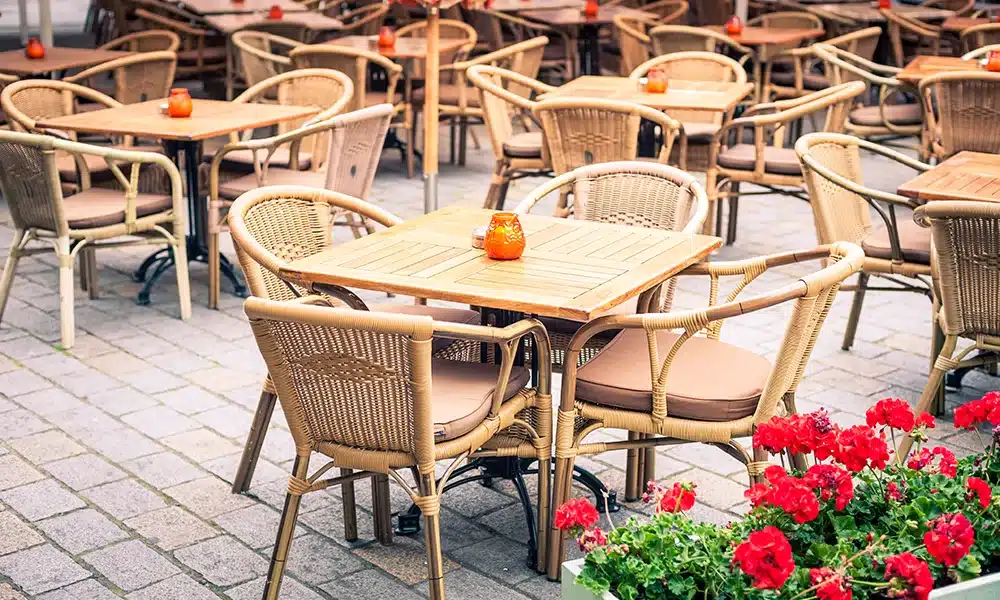
Rope weave chairs with aluminium frames outside a restuarant cafe - commercial dining furniture

Wind exposure and weighted bases: keeping tables where they belong

“How to stop outdoor tables blowing over” sounds dramatic until it happens. Wind can lift parasols, slide lightweight tables, and topple tall, narrow setups — especially in exposed beer gardens, roof terraces and coastal locations. Weighted bases and sensible proportions are the practical answer. A compact two-top on a stable, appropriately weighted base is often more reliable than a larger top on a lighter frame. It’s also worth thinking about what wind does to behaviour: guests pull tables together, bags hang on chair backs, and groups lean on edges. Your furniture needs to remain safe and stable under those real-world forces. For spaces where wind and flow are constant operational concerns, our Pub garden & terrace furniture page is a useful companion for wider layout thinking beyond individual pieces.
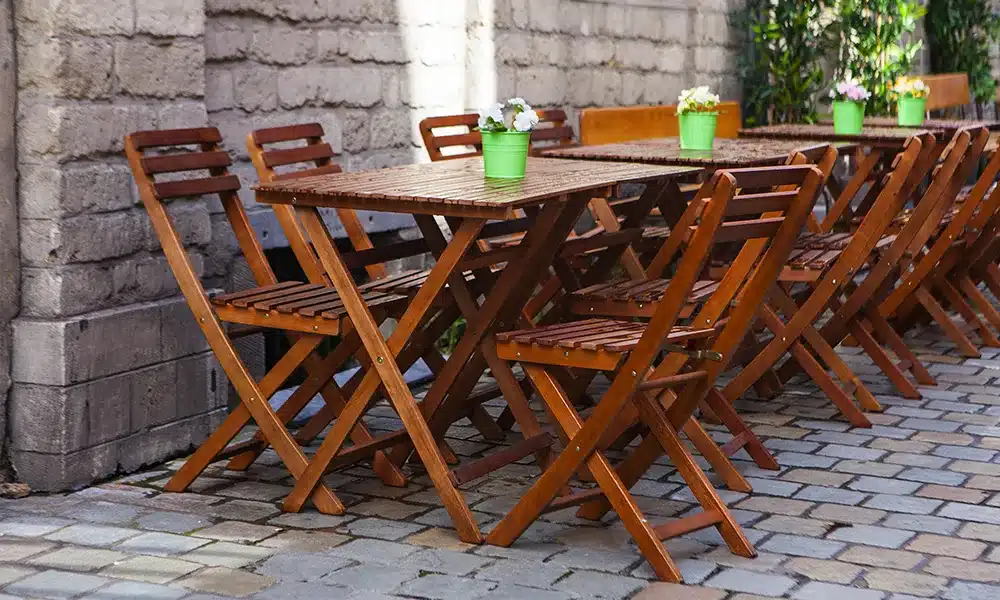
Rustic teak style chairs outside a commercial restaurant in the UK

Layout planning: service lanes, circulation and cover targets

Outdoor furniture succeeds when the layout supports service. A plan that squeezes in extra covers can backfire if staff can’t move cleanly, guests feel crowded, or tables become impossible to reset quickly.

Start by protecting the routes you can’t compromise: from doors to the terrace, from bar access points to key seating zones, and to any clearance needed for bins, planters, gates or fire routes. Then plan seating so tables can be accessed without staff having to “thread the needle” between chair backs.

A simple operational principle: if you can’t walk a tray through the space comfortably when it’s full, it’s too tight.

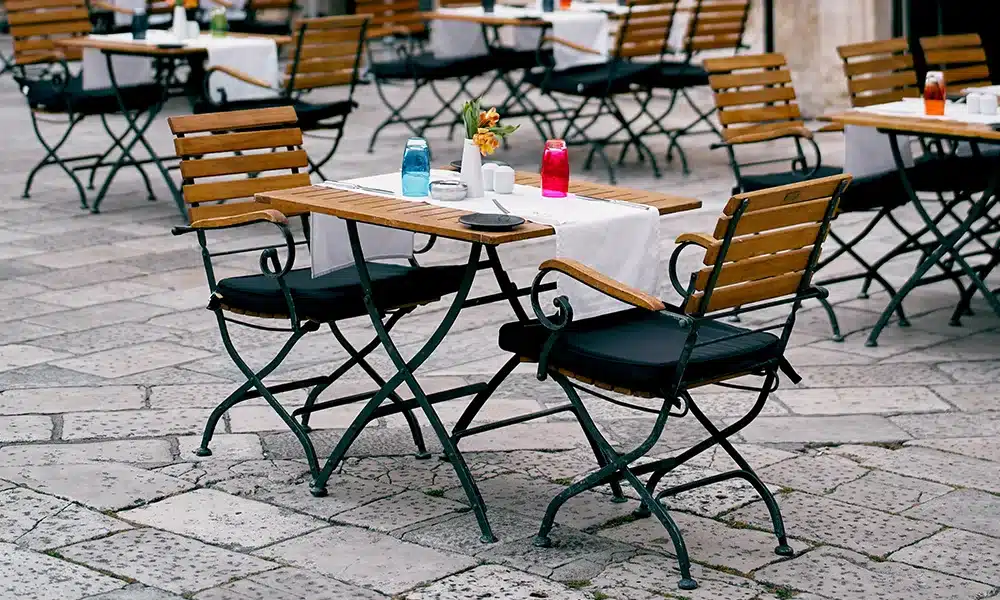
Teak Outdoor tables and chairs for commercial settings in the UK

Table sizes that give you flexibility: two-tops and four-tops

In pubs and cafés, flexibility often comes from controlling table sizes rather than constantly moving furniture. Two-tops are powerful because they fit in tight spots and can be combined when needed. Four-tops are efficient when you have consistent group demand, but they can reduce flexibility in mixed trading patterns.

A common, workable approach is a base plan that uses mostly two-tops with a smaller number of four-tops in “anchor” positions. That gives you the ability to accommodate couples, small groups, and occasional larger parties without re-laying the whole terrace every session.

Durable outdoor chairs for high footfall

Outdoor chairs in hospitality are dragged, stacked, scraped, and wiped constantly. The ideal chair is robust, easy to reset, and comfortable enough for a relaxed drink or meal — without becoming so bulky that it reduces covers or clutters service routes.

In high-footfall outdoor areas, durability is as much about how the chair ages as how it performs on day one. Finishes should resist scuffs and fading, and the chair should stay structurally solid under repeated movement. If chairs start to flex, wobble, or feel cheap, guests notice — and staff lose confidence in the setup.

Stackable chairs for outdoor cafés: storage and close-down reality

Stackability is rarely a “nice feature” — it’s a staffing and time issue. If your team can stack chairs quickly at close, cover them, or move them for cleaning and events, you reduce labour and protect the furniture from weather exposure when you’re not trading.

The best storage plan is the one your team will actually follow. If stacking is awkward, heavy, or requires too much space, it won’t happen consistently. That’s when furniture gets left out, deteriorates faster, and looks tired sooner than it should.

A practical tip: decide where stacks will live before you buy. If storage is tight, it may be better to choose lighter, stackable options than larger “statement” chairs that look great but create daily friction.

Materials for commercial outdoor use: a non-technical view

Material choice for outdoor café furniture and outdoor pub furniture doesn’t need to be overly technical — but it should be honest about trade-offs.

Some materials prioritise low maintenance and wipe-clean practicality. Others feel warmer and more premium but may demand more care, especially around fading, staining, or weathering. Your best choice depends on your exposure level and how disciplined you can be with maintenance.

If your outdoor area is fully exposed and you want the space to stay presentable with minimal effort, choose materials that don’t punish you for missed cover days or sudden rain. If you have partial cover and a strong close-down routine, you can broaden the aesthetic range while still staying practical.

Aluminium frame outdoor furniture built for commercial trade use by HCF Contract Furniture

Easy clean outdoor furniture for hospitality

Outdoor furniture gets cleaned more aggressively than indoor furniture — not only because of hygiene, but because the terrace needs to look “fresh” fast. Think about the cleaning products your team uses and the frequency of wipe-downs. Surfaces that tolerate regular cleaning without going sticky, patchy, or dull will hold their appearance longer.

Easy-clean is also about shape and detailing. Chairs with lots of grooves, woven textures that trap debris, or fiddly joints can slow cleaning down dramatically. In outdoor service, speed matters: the faster the reset, the more consistent the space looks throughout the day.

Outdoor furniture for pavement licensing areas

Pavement areas have their own realities: tighter footprints, public flow, licensing boundaries, and often higher visibility. You need furniture that stays within the permitted area, doesn’t drift into pedestrian routes, and can be reset quickly when you need to close down or reconfigure.

Stability matters more on pavements because surfaces are often uneven and wind can be channelled by buildings. It’s also worth planning for how furniture will be brought in and out — because many pavement licenses require removal outside trading hours.

Seasonal planning: covers, routines and lifespan

Outdoor furniture lifespan is heavily influenced by what happens when you’re not trading. The difference between furniture that looks good after three seasons and furniture that looks tired after one often comes down to routine.

A realistic seasonal strategy usually includes: regular wipe-downs, a sensible cover plan, and a clear approach to storage or protection during prolonged bad weather. The goal isn’t to eliminate maintenance — it’s to make it predictable and manageable so your outdoor area stays profitable rather than becoming a constant maintenance bill.

When outdoor tables and chairs pair well with fixed seating

Tables and chairs don’t always need to do all the work alone. In many outdoor spaces, fixed seating can create structure and improve flow, with loose tables and chairs filling the remaining flexibility.

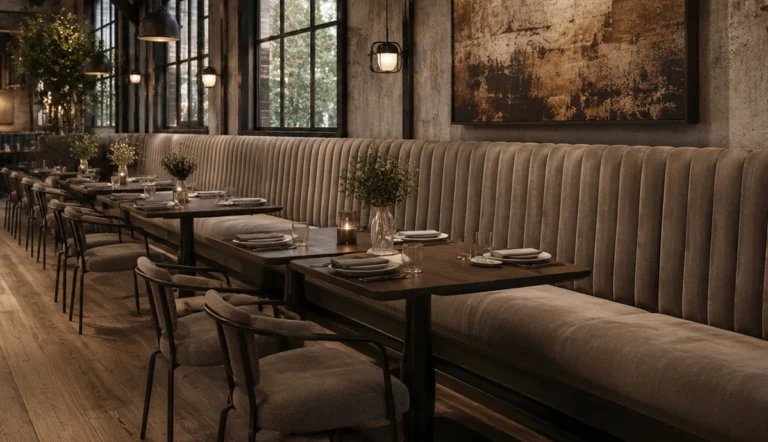
Outdoor banquettes can be especially effective along boundaries and walls, keeping the centre open and reducing chair drift. If you’re considering that approach, see our Outdoor booth & banquette seating page for how fixed outdoor seating changes layout, circulation, and maintenance compared to loose setups.

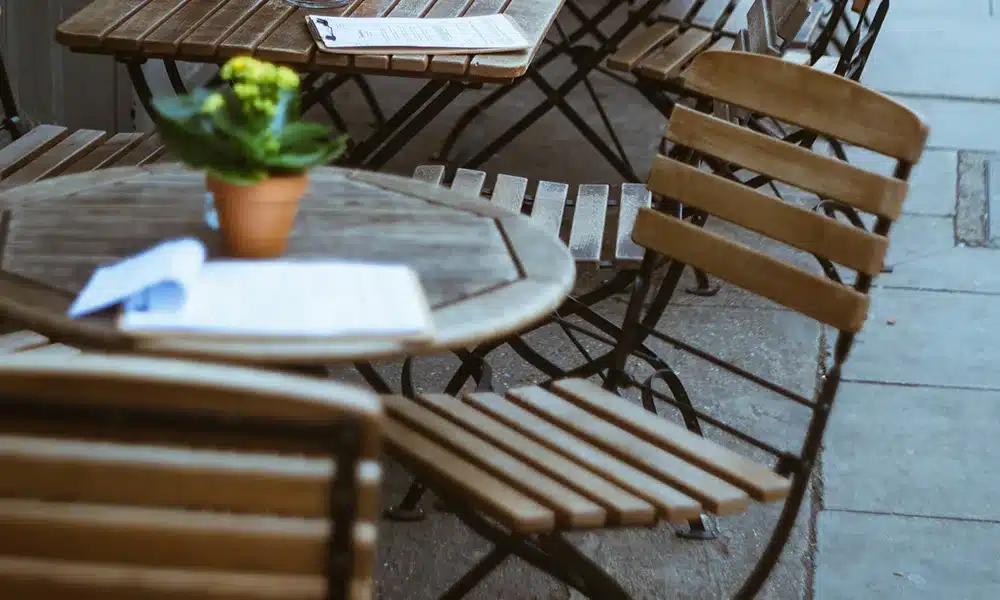
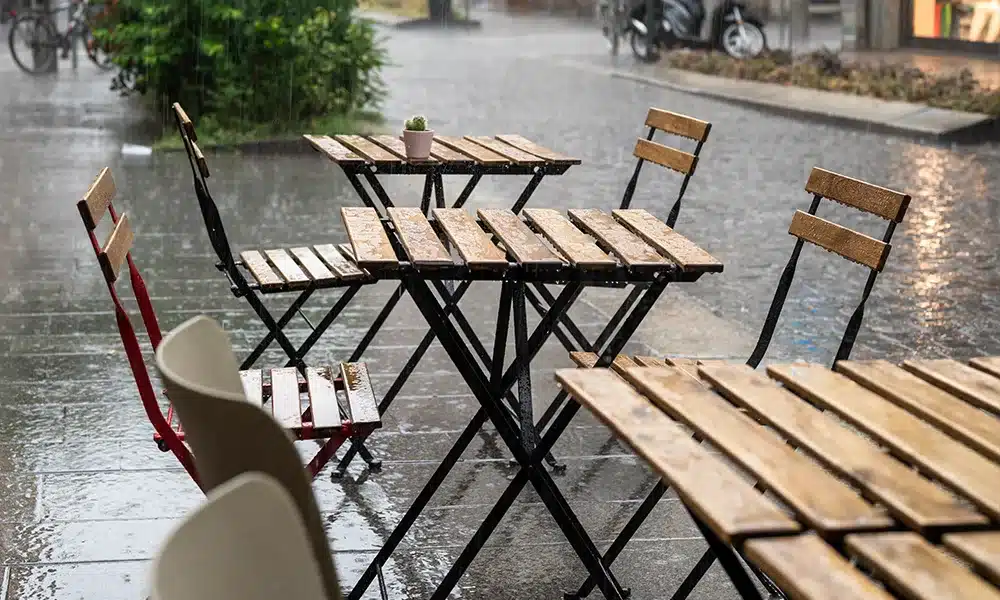
Wooden and Metal chairs outdoors on a rainy day in the UK - Commercial Trade Furniture

Outdoor systems vs indoor systems: a quick note

Some operators try to reuse indoor table logic outdoors — swapping tops and bases like an indoor system. Outdoors, the requirements change: exposure, wind stability, and cleaning regimes place different demands on bases and fixings.

If you’re reviewing indoor table components for inside spaces as part of a wider project, our Table tops and Table bases categories are useful references — but outdoor furniture should be specified as an exterior-ready solution, not an indoor system moved outside.

Talk to us about your outdoor layout and furniture mix

If you’re expanding outdoor covers, refurbishing a terrace, or trying to make a pavement area easier to run day to day, we can help you choose tables and chairs that suit your site conditions, service routes and close-down routine.

Start at Outdoor commercial furniture and share your dimensions, photos and cover targets for a clear, project-ready recommendation.

Outdoor Chairs & Tables FAQs

What are the best outdoor tables and chairs for pubs?
The best choice is furniture that stays stable in your conditions, resets quickly, and remains presentable under constant use. For exposed pub gardens, prioritise robust chairs and tables with appropriately weighted bases and practical, easy-clean surfaces.
How do I choose outdoor furniture for a café?
Start with footprint and routine. If you’re on a pavement, choose furniture that’s stable, space-efficient and easy to bring in/out. If you’re on a terrace, focus on service lanes, flexible table sizing (two-tops are useful), and chairs that stack or store easily.
What outdoor tables won’t wobble on patios?
Look for stable base designs suited to your table top size, and avoid tall, narrow setups on uneven surfaces. Reducing the number of table sizes across the terrace can also help keep stability consistent. The majority of our table bases come equipped with anti-slip, self leveling feet to prevent wobbles.
Are stackable chairs worth it for outdoor cafés?
Usually, yes. Stackable chairs make daily close-down, cleaning, and bad-weather protection significantly easier, which can extend furniture life and reduce labour.
How can I stop outdoor tables blowing over?
Choose table sizes and base weights that suit your wind exposure, keep parasol use realistic for the site, and avoid unstable combinations (large tops on light bases). In exposed locations, stability should be treated as a safety and service issue, not just a comfort preference.

See Our Other Inspiration Posts and Guides

Banquette seating in a dimly lit restaurant interior, live oak wood walls and chairs around the room
Read More
Large Nook Acoustic Pods in an office space, brightly lit room and internal lights light up the interior of the meeting pods
Read More
A stack of fabrics in patterned designs on a table
Read More

What are you looking for?