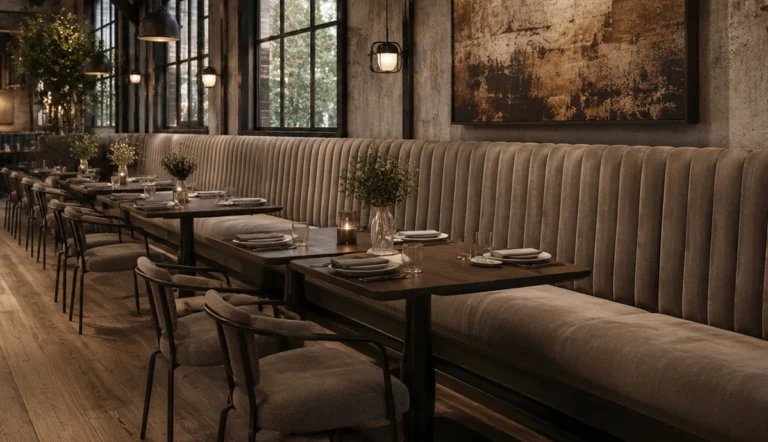
How Much Space Do You Need for Banquette Seating in a Restaurant?

Space planning is one of the most commercially important decisions you’ll make when designing a restaurant. Every square metre needs to work hard—balancing customer comfort, staff efficiency and overall seating capacity. This is where banquette seating consistently proves its value.

Unlike loose tables and chairs, banquette seating allows you to structure space with intent. They reduce wasted circulation areas, create cleaner layouts, and often increase the number of covers you can achieve within the same footprint. But the question remains: how much space do you actually need for banquette seating?

This guide breaks down the real-world thinking behind banquette seating space requirements, helping you understand how seating depth, table size and aisle width work together, and how different layouts affect both capacity and experience.

For a broader overview of booth styles and configurations, see The Ultimate Guide to Commercial Booth & Banquette Seating.

Why Banquette Seating Is More Space-Efficient Than Loose Seating

The biggest advantage of banquette seating is its ability to use perimeter space effectively. Instead of pulling chairs in and out, which requires clearance on all sides, banquettes sit flush against walls or back-to-back in the centre of the room.

This simple shift has a noticeable impact. You eliminate unnecessary gaps behind chairs, tighten table positioning, and create more predictable walkways. Over the course of a full layout, this can translate into a meaningful increase in seating capacity.

A side by side comparison floorplan of a restaurant, one side with banquette seating and the other with chairs and tables only

In practical terms, banquette seating often allows operators to:

  • Fit more covers along walls and corners
  • Create consistent table spacing
  • Reduce dead space between seating zones

This is why it’s such a common choice in high-performing hospitality environments, particularly where every seat contributes directly to revenue.

How Seating Depth, Table Size and Aisle Width Work Together

When thinking about banquette seating space requirements, it’s not about a single measurement. It’s about how three elements interact: the depth of the seat, the size of the table, and the width of the aisle behind it.

The seating depth determines how far into the room your banquette projects. Table size dictates how much space diners need in front of them. And aisle width affects how easily staff and guests can move through the space.

A typical arrangement might feel efficient on paper, but if the aisle is too tight or the table too large for the seat pitch, the layout quickly becomes uncomfortable or impractical.

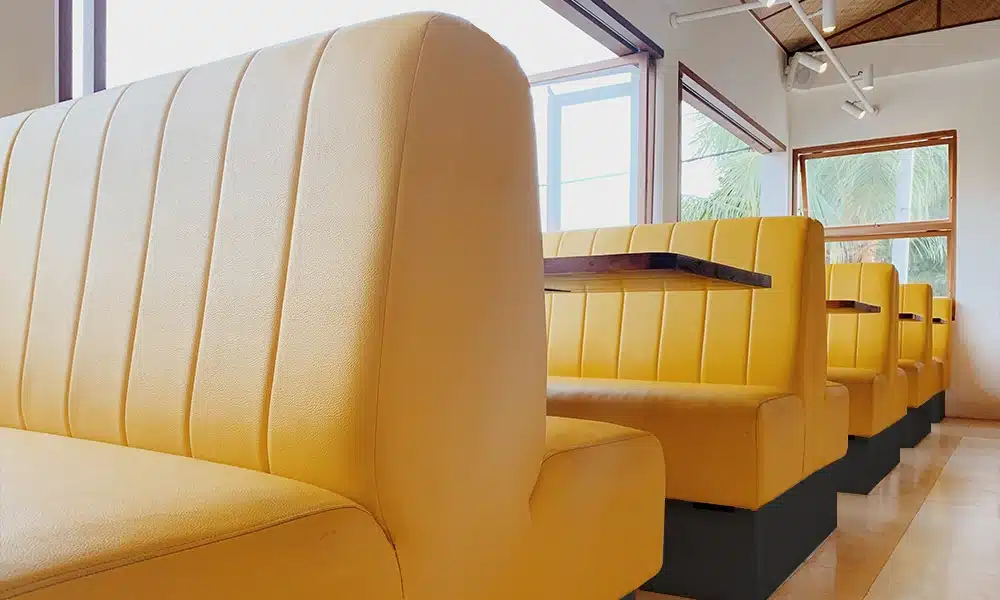
Yellow fluted back-to-back booth seating in a bright white café diner interior

This is where many layouts fall short. They treat each dimension in isolation rather than considering the overall relationship between them.

If you want a deeper breakdown of how seat depth and height influence layout planning, it’s worth reviewing Booth Seating Dimensions Explained, which connects these details back to real-world spacing decisions.

Understanding Restaurant Booth Spacing Guidelines

While there’s no single “correct” measurement, there are widely accepted spacing principles that guide successful layouts.

The key is to create enough room for:

  • Comfortable dining (without feeling cramped)
  • Smooth staff circulation
  • Easy access to and from seats

In UK restaurant layouts, aisle widths are often one of the biggest deciding factors. Too narrow, and service becomes difficult. Too wide, and you lose valuable seating capacity.

Rather than aiming for rigid numbers, it’s more useful to think in terms of balance. A slightly tighter layout may work well in a fast-casual setting, while a premium dining environment will require more generous spacing to match the experience.

Ultimately, the goal is not just to fit more tables—it’s to ensure those tables function properly throughout service.

Wall Banquettes: The Most Efficient Use of Space

Wall-fixed banquettes are typically the most space-efficient configuration. By running seating along the perimeter, you free up the centre of the room for circulation and additional tables.

This approach works particularly well in:

  • Narrow restaurant layouts
  • Long, rectangular floorplans
  • Café-style environments

Because you only need circulation space on one side of the table, you can position tables closer together without compromising usability. This makes wall banquettes one of the best options for maximising covers.

high back run of banquette seating in a button back design with chairs and tables opposite

Many operators combine wall banquettes with loose chairs on the opposite side, creating a flexible yet space-efficient layout. This also allows you to adjust seating arrangements more easily when needed.

For practical examples of how this works in real venues, see Restaurant Booth Seating (UK-Made Banquette Seating for Restaurants).

Red plain back booth seating in Wimpy restaurant, made by HCF Contract Furniture

Double-Sided Booths: Structured Layouts with High Capacity

Double-sided booths (back-to-back seating) are often used in the centre of the restaurant floor. These create structured rows of seating, similar to classic diner layouts or modern casual dining environments.

From a space planning perspective, they’re highly efficient—but only when used correctly.

Because both sides of the booth are fixed, you need to carefully plan aisle widths on either side. If these are too tight, staff movement becomes restricted. If they’re too wide, the efficiency benefit is lost.

Double-sided booths work best when:

  • The space is wide enough to accommodate clear walkways
  • The layout is repetitive and modular
  • You want to create a strong visual structure in the room

They’re particularly effective in larger venues where consistency and flow are key to service speed.

Corner and L-Shaped Banquettes: Unlocking Awkward Spaces

Corners are often underused in restaurant layouts. Traditional tables and chairs struggle to utilise these areas efficiently, which leads to wasted floor space.

This is where corner banquette seating becomes valuable. By wrapping seating around the corner, you turn an awkward area into a functional seating zone.

Corner layouts are especially useful for:

  • Smaller restaurants where every metre counts
  • Irregular floorplans
  • Creating semi-private dining areas

They also improve the perceived comfort of a space. Guests often prefer corner seating because it feels more enclosed and less exposed to foot traffic.

From a planning perspective, corner banquettes allow you to increase covers without expanding your overall footprint—making them a smart solution for compact venues.

Banquette Seating for Small Restaurants and Tight Spaces

In smaller venues, space planning becomes even more critical. You’re not just designing for comfort—you’re designing for viability.

Banquette seating is often the difference between a workable layout and one that feels cramped or inefficient.

Slimmer-depth options, such as space-saving booth designs, allow you to reduce the overall footprint of each seating run while still maintaining comfort. These are particularly effective in cafés, narrow restaurants and high-street units.

In tight spaces, it’s also important to think about flexibility. Smaller tables that can be pushed together or separated give you more control over how the space is used throughout the day.

If you’re working with limited floor area, this guide to banquette seating for small spaces offers additional layout strategies.

Beautiful interior designed restaurant with people sitting on banquette seating in a booth configuration

Balancing Capacity with Customer Comfort

Maximising covers is important—but it should never come at the expense of the dining experience.

A layout that feels overcrowded can negatively impact:

  • Customer comfort
  • Perceived quality of the venue
  • Staff efficiency during service


Banquette seating makes it easier to strike the right balance because it creates defined seating zones. High-back designs, for example, can provide a sense of privacy even in tighter layouts, helping the space feel more comfortable without increasing the physical footprint.

This is particularly useful in busy restaurants where noise levels and foot traffic are higher. Thoughtful spacing combined with the right seating style can make a compact space feel far more considered.

How Layout Decisions Affect Staff Movement and Service

It’s easy to focus purely on guest seating, but staff movement is just as important when planning your layout.

Aisles that are too narrow slow down service, increase the risk of collisions, and make it harder to clear tables efficiently. On the other hand, overly wide walkways reduce the number of covers you can achieve.

Banquette seating helps create clearer circulation paths because the layout is more structured. Instead of unpredictable chair movement, you have fixed seating lines that define where people move.

When planning your layout, consider:

  • Main service routes between kitchen and tables
  • Access points to each seating area
  • How staff will carry trays and clear tables

A well-planned banquette layout supports smoother service, which ultimately improves both efficiency and customer experience.

How to Assess How Much Space You Really Need

There’s no universal answer to how much space you need for banquette seating. It depends on your concept, service style and the type of experience you want to create.

A fast-paced café may prioritise higher density and quicker turnover, while a premium restaurant will require more generous spacing and a slower, more relaxed feel.

The most effective way to approach this is to work backwards:

Start with your target number of covers, then consider how those covers will be distributed across the space. From there, you can refine the layout by adjusting table sizes, seating configurations and aisle widths.

Banquette seating gives you more control over this process because it allows you to design the layout around your goals, rather than adapting to the limitations of loose furniture.

Planning a Banquette Seating Project?

Banquette seating is one of the most effective tools for improving restaurant layout efficiency—but it’s not just about fitting more seats in.

The best layouts balance capacity with comfort, structure with flexibility, and efficiency with atmosphere. When done well, banquette seating doesn’t just maximise space—it enhances how the space feels and functions.

As a UK manufacturer of contract-grade booth seating, we can advise on sizing precision, compliance, lead times and long-term durability — without obligation.

Get in touch to discuss your drawings, timelines and budget, and we’ll help you decide which route is right for your venue.

Banquette Seating Space Planning FAQs

How much space do you need for banquette seating in a restaurant?
It depends on the layout, but the key is balancing seat depth, table size and aisle width. Banquettes typically allow tighter, more efficient layouts than loose seating.
What is the minimum aisle width for restaurant seating in the UK?
There’s no single rule, but aisles need to comfortably accommodate both staff and guests. The right width depends on your service style and traffic levels.
Is banquette seating better for small restaurants?
Yes, in most cases. It reduces wasted space and allows you to maximise seating capacity, especially along walls and in corners.
How do you maximise covers with banquette seating?
Use wall seating, optimise table sizes, and minimise unnecessary gaps. Structured layouts like double-sided booths can also increase capacity when space allows.
Are booths more space-efficient than tables and chairs?
Generally, yes. Booth seating eliminates the need for clearance behind chairs, allowing for tighter and more consistent spacing.

See Our Other Inspiration Posts and Guides

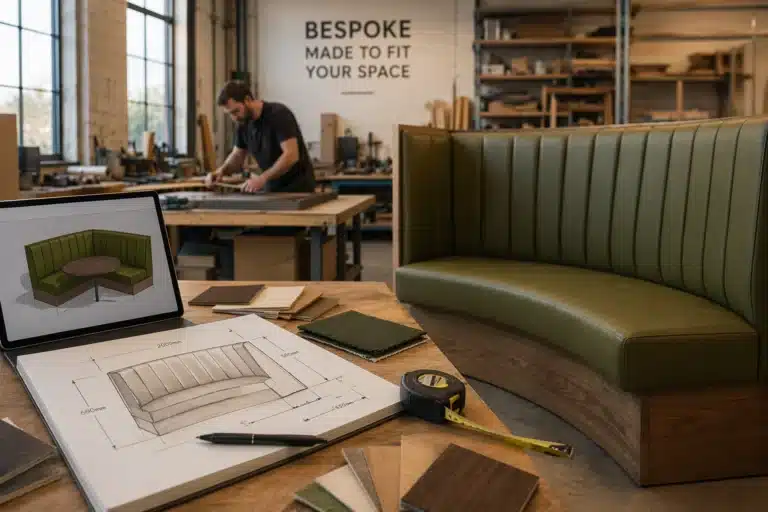
Bespoke banquette seating unit in a factory workshop, showing the breakdown of making a banquette unit
Read More
UK Cafe fixed seating run against a wall in a modern scandi style cafe, bespoke banquette manufactered by HCF Contract Furniture
Read More
A small restaurant interior with compact banquette seating and booth seating inside, showing how space can be saved with the right contract furniture
Read More
author avatar
HCF Editorial Team Editorial Team
The HCF Contract Furniture Editorial Team brings together decades of experience designing and manufacturing UK-made contract furniture for restaurants, bars, pubs, hotels and hospitality venues. All content is written and reviewed by our in-house team using real manufacturing knowledge, project experience and industry standards, including Crib 5 compliance and contract-grade specifications.

Leave a Reply

Your email address will not be published. Required fields are marked *

What are you looking for?