Council Offices & Civic Building Furniture
Council offices and civic buildings are some of the UK’s most mixed-use interiors. A single reception can serve residents coming in for a quick query, families waiting for an appointment, people attending a community session, and staff moving between front-of-house and back-office tasks. That variety creates one big challenge for furniture: it has to be robust and inclusive enough for constant public access, while still feeling calm, welcoming and “official” rather than improvised.
This page is a practical guide to council office furniture, civic building furniture and local authority furniture decisions that affect daily operations: waiting behaviour, queues and privacy, high-footfall durability, cleaning, accessibility, and phased refurbishment across multiple sites. We’ll keep the focus on front-of-house and public-facing areas (plus light-touch meeting needs) without drifting into hospitality styling, domestic furniture advice or workstation engineering.
If you’re mapping procurement across public-facing environments, our Public & Healthcare Furniture hub is the best place to start within HCF’s structure.
Why civic buildings need a different approach to furniture
Civic buildings don’t behave like offices. In a workplace breakout area, people choose to be there and typically understand the “rules” of the space. In a council waiting area, the rules are implicit and the users are varied—some anxious, some frustrated, some with mobility aids, some with children, some needing privacy at the desk. Furniture has to quietly shape behaviour: where people queue, where they sit, how long they dwell, and how easily staff can reset the space between rushes.
That’s why public sector furniture often performs best when it’s deliberately simple: supportive seating, sensible spacing, durable finishes, and layouts that don’t create pinch points. The goal is not to make people linger, but to make waiting feel fair, comfortable and orderly.
Furniture for council reception areas: what matters first
Reception is where civic buildings win or lose confidence. People arrive, look for direction, and decide—within seconds—whether the space feels organised and respectful. Reception furniture should support clear wayfinding and protect staff operations, especially around queue formation and privacy.
A well-planned reception area typically has three “behaviour zones”: a standing/queue zone, a short-wait zone close to reception for those who need it, and a main waiting zone slightly offset from the desk. Keeping those zones distinct reduces congestion and stops seated visitors from feeling like they’re part of the queue, which is a common friction point in busy council buildings.

Best seating for council waiting rooms
When specifiers ask for the best seating for council waiting rooms, we usually translate that into three requirements: inclusive comfort, easy maintenance, and resilience to heavy daily use. Inclusive comfort means people can sit down and stand up without struggle (arms help here), and there’s a mix of seating types for different needs without creating a “special chair” stigma.
Maintenance is about both materials and design details. A chair can be technically wipeable but still hard to keep clean if it’s full of seams, deep creases and dust traps. Resilience is about frames that don’t wobble, finishes that don’t chip immediately, and upholstery that can cope with repeated cleaning.
For a broad view of contract-ready seating types suitable for public access spaces, our Chairs & stools category is a helpful starting point.
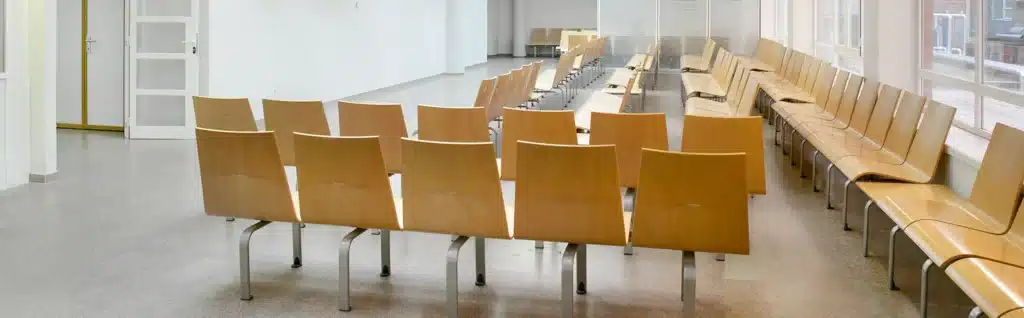
Public sector reception seating that is easy to clean
“Easy to clean” matters in civic buildings for two reasons: hygiene standards and public perception. Even when dwell times are short, the seating is in near-constant rotation. If cleaning takes too long, staff skip the hard bits; if marks show easily, the room looks uncared for.
Look beyond “wipeable” as a label and consider the realities: frequent contact points (seat front edges and arm tops), high abrasion, and the inevitability of occasional spills. Simple silhouettes, fewer joins, and robust edge detailing tend to stay presentable longer and make daily cleaning feel achievable rather than burdensome.
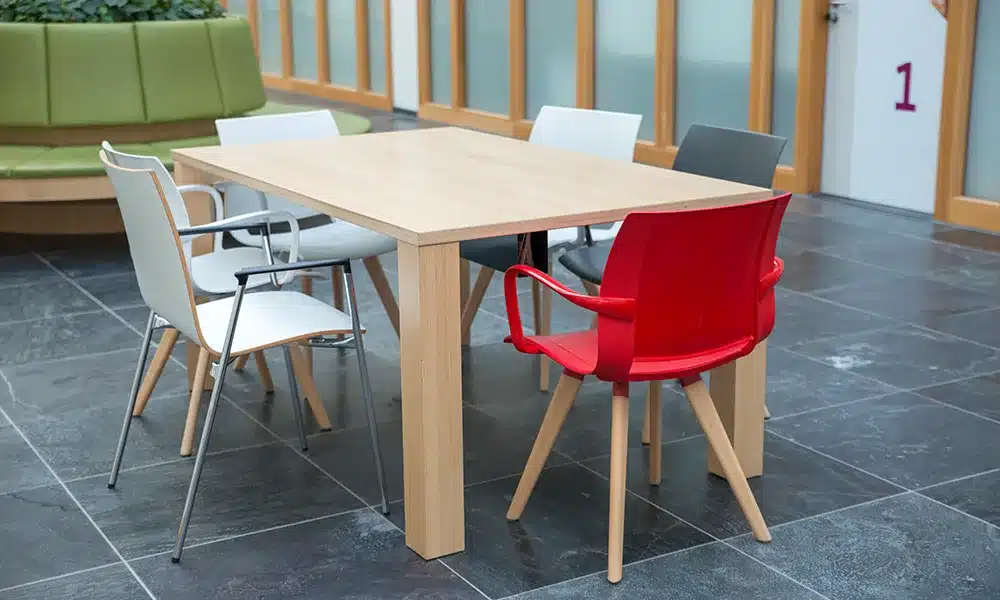
Wipeable seating for public buildings: getting the balance right
Accessible seating for council buildings
Accessibility isn’t one designated corner; it should be built into the layout and the seating choice. In practice, inclusive waiting areas are those where:
- there’s space for wheelchair users without having to move furniture
- routes remain clear for mobility scooters, buggies and walking aids
- some seats have arms to support sit-to-stand
- seat heights feel “easy” rather than low lounge level
What makes this challenging is that accessibility can be unintentionally designed out during refurbishment—when extra chairs are squeezed in, or when a “tidy look” leads to tighter spacing. It’s worth protecting accessibility space on the plan early, then furnishing around it, rather than trying to “make room” later.
Durable seating for high footfall public buildings
High footfall shows up in predictable ways: chair legs scrape, arms get polished by constant use, and the same few seats near the desk get hammered all day. That’s why durable contract furniture for councils is less about a single “strong material” and more about an honest, contract-grade build: stable frames, sensible weight and balance, and finishes that don’t degrade under repeated cleaning.
For estates teams managing multiple sites, durability is also a standardisation issue. If each site uses a different chair style, replacements become a constant headache. A small range of approved models (with controlled finish options) usually reduces maintenance, simplifies procurement, and keeps the public experience consistent.
Council refurbishment furniture planning: how to avoid the “patchwork” look
However good a chair looks in the brochure, it needs to cope with real life: red wine spills, food smears, denim rivets, takeaway spills and constant cleaning. Thinking about restaurant chair maintenance & cleaning early on will save you time and money later.
In high-spill areas, faux leathers and contract vinyls are often a better choice than textured weaves. They wipe clean quickly and don’t trap crumbs, which is invaluable in chairs for busy restaurants. For wooden restaurant chairs, a durable lacquer or stain with a clear topcoat makes it easier to remove marks without sanding back to bare timber.
Metal restaurant chairs with powder-coated frames are surprisingly forgiving; minor knocks are less visible and frames can be wiped down with standard cleaning products. We design our commercial restaurant chairs so that glides can be replaced, joints can be tightened and seat pads can be reupholstered – extending the life of your investment instead of forcing you into full replacement when fabrics start to date.

Town hall, reception and public counter tables
Many civic buildings need small “public-use” table moments: a place to fill in forms, a low-key consultation table, or a surface near reception for leaflets and information. The tables in these areas need to be robust, stable, and easy to clean—without turning the reception into a meeting room.
If you’re specifying occasional-use tables for public spaces, start at category level and keep it simple: durable tops that clean easily and bases that don’t wobble or create trip hazards. For high-level browsing, see our Table tops and Table bases categories.
Fire safety and Crib 5 context for public sector seating
Council estates often require clear documentation around fire performance, especially when upholstered seating is used in public routes and reception environments. We won’t go into detailed regulatory interpretation here, but it’s sensible to treat upholstery choices as part of your compliance conversation—particularly if you’re re-covering existing seating or mixing old and new across phases.
For practical context on Crib 5 expectations and how upholstery choices can intersect with compliance decisions, see our Fire safety & Crib 5 regulations for hospitality seating pillar.
Replacing worn seating in council buildings: refurbish vs replace
Public buildings often have seating that is structurally sound but visually tired—split covers, flattened foam, stains that won’t lift, or chairs that no longer look “clean” even after a thorough wipe-down. In those cases, it’s worth considering whether a lifecycle refresh could extend value, especially when you’re working through phased refurbishments and want to minimise disruption.
Refurbishment can be a practical option when frames are still strong and you’re mainly solving hygiene, appearance and consistency. Replacement is usually the better call when furniture is unstable, damaged, or likely to fail in the short term. The right answer is often a blend: refresh what can be brought up to standard, and replace the pieces that are past the point of sensible maintenance.
When refurbishment is part of your plan, our Booth & banquette seating re-upholstery services page explains how we approach re-covering and the sort of projects it suits.
How to choose furniture for civic buildings: a procurement mindset that holds up
Public sector procurement isn’t just about today’s price—it’s about service continuity, lifespan, and the cost of disruption. The most reliable decision-making framework is to specify backwards from operational reality:
Think about your busiest periods and the behaviour they create. Where do queues form? Where do people cluster? Where do mobility aids need space? Then consider what staff have to do daily: clean, reset, move through the area, and respond to issues without constantly rearranging furniture.
Finally, align the specification across sites. Even if each building has its quirks, a shared approach to seating height, arm options, wipeable finishes and layout principles will reduce long-term complexity. It also makes future refurb phases faster, because you’re not reinventing the wheel each time.
Talk to us about your council furniture project
If you’re planning a reception refresh, phased upgrades across multiple sites, or need hard-wearing seating that stays presentable under heavy public use, we can help you specify a practical, consistent solution.
Browse Chairs & stools for waiting and reception seating, or start at Public & healthcare furniture and send us your floor plan and priorities for a fast, workable recommendation.
- sales@hcfcontract.co.uk
- 01708 331757
Council Office & Civic Building Furniture FAQs
See Our Other Inspiration Posts and Guides