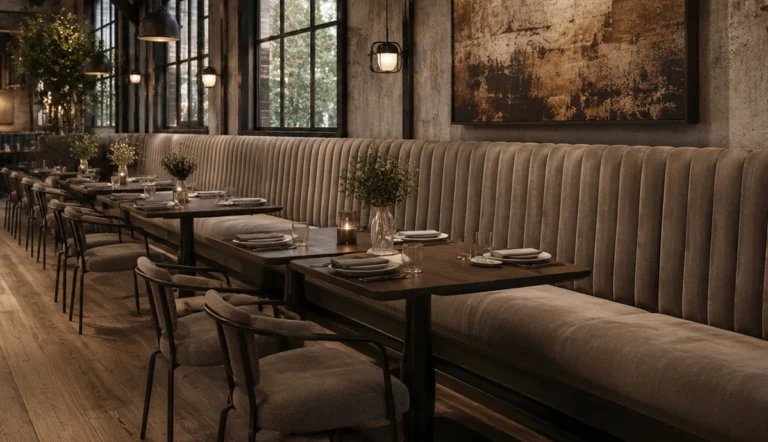
5 Captivating Booth Seating Layouts for Your New Restaurant

Smart seating plans can make or break a new restaurant. In this guide, we break down five powerful booth seating layouts – from intimate alcoves and corner booths to round booth seating, islands and L-shaped banquettes – to help you maximise covers, define your brand and create a dining room guests love.
Plan Your Layout With HCF

The Unseen Power of Restaurant Layout

When you’re opening a new restaurant, you naturally focus on the menu, branding and décor. But one element quietly shapes every guest’s experience from the second they sit down: your seating layout.

A well-planned layout does far more than “fit in as many tables as possible.” It influences:

Thoughtful booth seating and banquette seating layouts give you a powerful way to control flow, atmosphere and capacity in a single stroke.

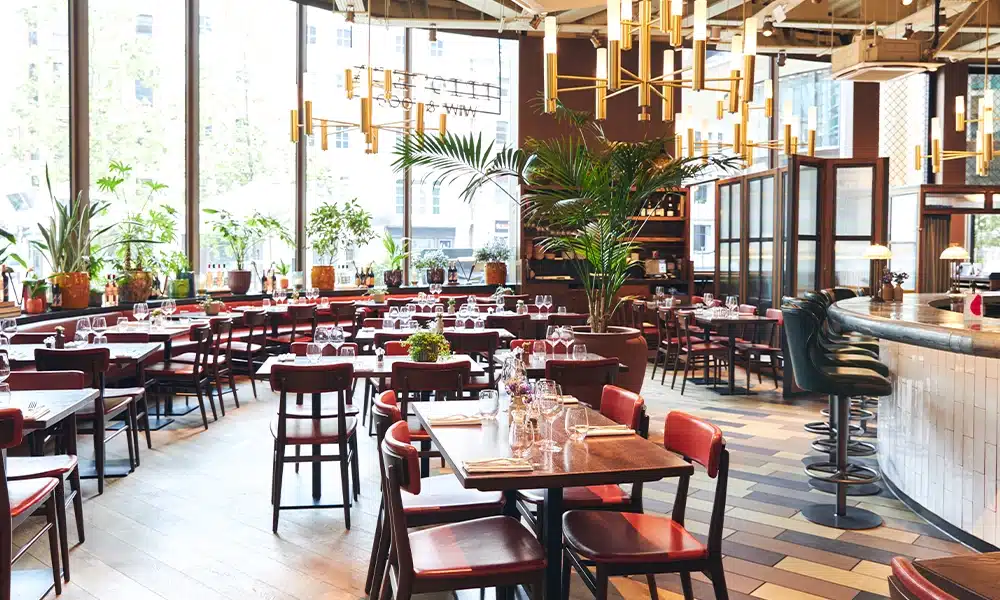
Large open plan restaurant with tables and chairs in the centre and booth seating around the outer perimeter

Why Booth Seating is a Game-Changer for New Restaurants

Booth seating has a special place in commercial restaurant design. It instantly adds comfort and privacy, helps you make narrow or awkward spaces usable, and gives the room a more “designed” feel than rows of loose chairs alone. A well-planned combination of booth seating, round booth seating, corner booth seating and banquettes can turn an empty box into a layered, atmospheric dining room.

At HCF Contract Furniture, we design and manufacture commercial booth seating, round booth seating, corner booth seating, modular banquettes, table tops, table bases, and chairs and stools – all made to order for UK restaurants, cafés, bars and hotels.

Explore our core booth and banquette seating ranges here.

What You’ll Discover: Beyond Just a Seat

In this guide, we’ll walk through five proven booth seating layouts you can use to shape your new restaurant:

  1. The Intimate Alcove
  2. The Linear Maximizer
  3. The Social Curve
  4. The Flexible Island
  5. The Adaptable L-Shape


We’ll explore how each approach affects atmosphere, capacity and flow – and how to choose the right mix for your concept.

The Strategic Advantage of Booth Seating in Restaurant Design

Enhancing Customer Comfort and Satisfaction

Ask most diners where they’d rather sit – a freestanding chair or a booth – and the booth nearly always wins. High backs, defined boundaries and deep cushions create a sense of security and comfort that’s hard to achieve with tables and standard chairs alone. Guests feel less exposed, less distracted and more inclined to settle into the experience, which is exactly what you want if you’re building loyalty and encouraging that extra drink or dessert.

If you’re new to banquettes and want a deeper dive into their benefits, our Ultimate Guide to Commercial Booth Seating is a great companion read.

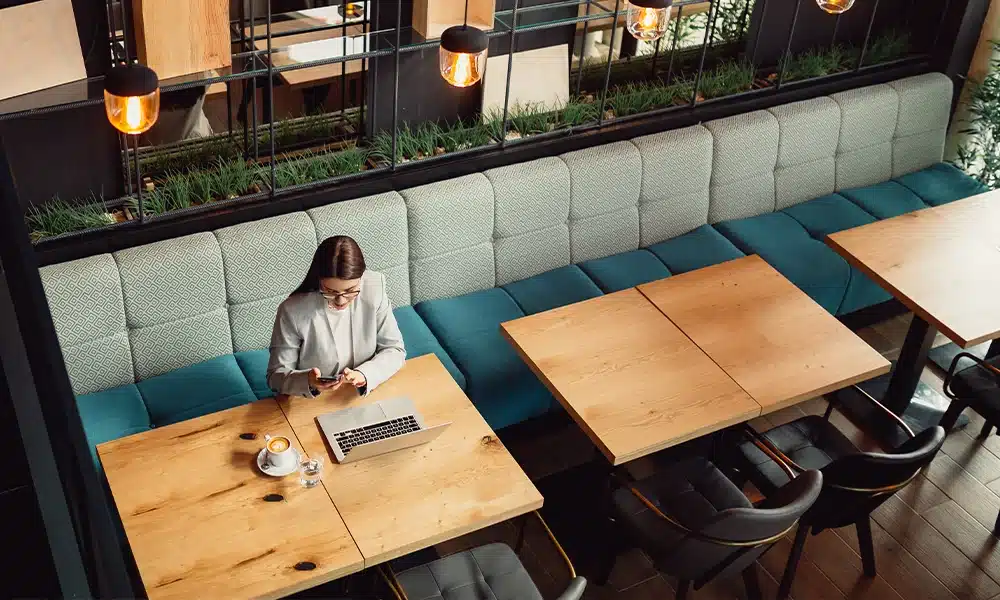
anquette seating along a glass wall with café tables opposite and a woman sitting with a coffee

Defining Ambiance and Brand Identity

Your seating layout is also a major part of your brand story. For example:

  • Round booth seating can feel glamorous and sociable
  • Corner booth seating feels intimate and tucked away
  • Long runs of restaurant booths can give a contemporary, brasserie-style atmosphere


With HCF’s wide range of cover choices – from faux leather to high-performance fabric – you can tune your seating to match your brand, whether that’s relaxed neighbourhood bistro or high-end dining room.

Durability and Maintenance Benefits​

For all the interior design thinking, restaurant seating is a functional piece of equipment. It has to withstand constant use, cleaning and the occasional knock without deteriorating. HCF booths are built with robust frames, high-density foams and Crib 5 compliant materials, so when you commit to a booth-heavy layout you’re investing in something that will perform under real-world conditions, not just look good in a CAD drawing.

That means your layout choices aren’t just about aesthetics – they’re long-term operational decisions that affect cleaning, maintenance and performance for years.

Layout 1: The Intimate Alcove – Fostering Privacy and Connection

Horseshoe shaped deep fluted Booth Set in a complely white studio, showing curved corners on a U shape booth set

Characteristics of Alcove Booths (U-Shaped and Corner Nooks)

The Intimate Alcove layout is all about tucking guests into their own little world. It’s built around U-shaped booths and carefully designed corner booth seating, often placed in alcoves, window bays or quieter edges of the dining room. These settings frame the table on two or three sides, often with higher backs, to give diners an immediate sense of enclosure and separation from the rest of the room.

To heighten that cocooned feeling, many operators treat these alcoves almost like mini rooms within the restaurant. Thoughtfully chosen wall art above the back of the booth, warm lighting and a few well-placed accessories can make each nook feel curated and personal. Introducing a natural element – such as planting, timber finishes, or textured materials – softens the built-in seating and stops the space feeling boxed in. Together, the shape of the booth, the artwork and those natural touches create intimate corners that feel special, calm and deliberately designed, rather than just somewhere the spare table ended up.

Our dedicated corner booth seating range is designed specifically to turn underused corners into premium, bookable spots.

Strategic Advantages: Intimacy, Exclusivity, and Quiet Conversation

This layout shines when you want:

  • Romantic or special-occasion dining
  • Quiet conversation zones away from high-traffic routes
  • Small groups to feel looked-after and “tucked away”


These booths naturally encourage guests to relax, stay longer and order that extra drink or dessert.

Ideal Restaurant Concepts: Fine Dining, Romantic Bistros, Cozy Cafés

The Intimate Alcove works beautifully in:

  • Fine dining restaurants wanting private-feeling tables
  • Romantic bistros or wine bars
  • Smaller cafés where you want to carve out a “cosy corner” experience


Pair your alcove booths with warm lighting, quality table tops and considered wall finishes to complete the effect:

Design Considerations for Enhancing the Alcove Experience

To get the most from this layout:

  • Use high-back restaurant booths for privacy and acoustic comfort
  • Plan enough space for staff to access the tables comfortably
  • Consider integrating banquette seating with storage in smaller venues


See our guide to banquette seating with storage

Layout 2: The Linear Maximizer – Efficient Capacity and Clear Pathways

A long run of horizontal fluted banquette seating next to eachother showing a line of seating. a woman sits on one end

Understanding Linear Booth Seating (Single-Back and Double-Back Booths)

The Linear Maximizer is the classic restaurant workhorse. It uses straight runs of booth seating or banquette seating along walls and in the centre of the room. Single-back booths or banquettes sit against the perimeter; double-back (back-to-back) booths form “spines” down the middle of the dining floor. Tables are then spaced along these runs to create a rhythm of consistent, efficient covers.

Strategic Advantages: Maximizing Seating Capacity and Operational Efficiency

This layout is one of the most efficient ways to use space. It lets you fit a high number of covers without guests feeling jammed together, and it creates clear, predictable routes for both staff and customers. From an operational point of view, servers can move along the runs in logical patterns, and reservations are easy to manage because the tables are more uniform in size and shape.

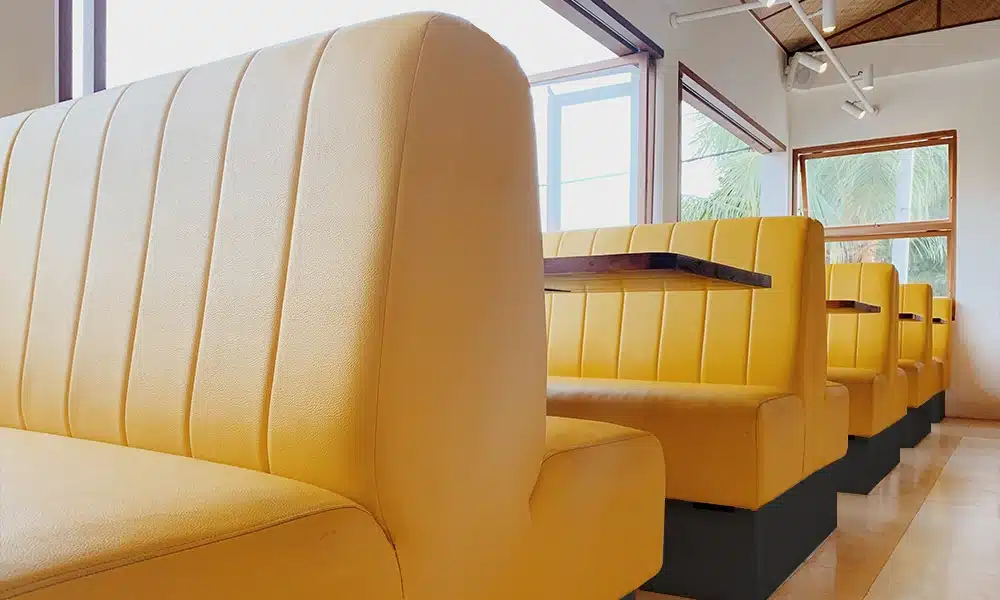
Yellow fluted back-to-back booth seating in a bright white café diner interior

Ideal Restaurant Concepts: High-Volume Diners, Casual Cafés, Family Restaurants

The Linear Maximizer is ideal for:

  • High-volume diners and casual restaurants
  • Family-focused venues where you need robust, wipe-clean commercial restaurant booths
  • Cafés with long walls or narrow floor plans


If you’re designing for a smaller footprint, our Ultimate Guide to Banquette Seating for Small Spaces is also worth a read.

Interior Design Considerations for Functional Linear Layouts

When planning linear layouts, the details around the tables themselves matter. Choosing the right table bases prevents guests from fighting with table legs when sliding into a booth

You’ll also want to keep aisle widths generous enough for staff carrying plates and trays, and ensure back heights sit well with windows, artwork and sightlines through the room. Linear layouts pair nicely with coordinated chairs and stools, which you can use opposite banquettes or at the ends of rows

Layout 3: The Social Curve – Encouraging Interaction and Soft Aesthetics

A round half booth set in plain back standard height in a white studio, showing the effect of a curved banquette seating layout. table is slightly greyed out to highlight the booth

Exploring Curved Banquette and Half Circle Booth Designs

The Social Curve layout uses curved banquette seating and round booth seating to soften the geometry of the room and create naturally sociable pockets. Instead of straight lines, you work with half circles, three-quarter circles or sweeping curves that wrap around central tables, often becoming visual focal points in the space.

Our dedicated round booth seating range makes it easy to introduce this dynamic shape into your restaurant.

Strategic Advantages: Promoting Communal Dining and Sociability

Curved booth layouts are brilliant for lively, social concepts. Because guests are arranged around the arc of the seat, they’re more naturally drawn into conversation. These booths feel perfect for sharing menus, small plates and celebratory meals, and they tend to attract groups who enjoy a buzzier atmosphere.

Ideal Restaurant Concepts: Trendy Eateries, Lively Bars, Social Lounges

The Social Curve is perfect for:

  • Trend-led eateries and small plates restaurants
  • Lively cocktail bars and social lounges
  • Casual concepts built around sharing and group experiences

Design Considerations for Dynamic Curved Layouts

With curved layouts, sizing and access are key. Tables need to be large enough for everyone to dine comfortably but not so large that guests struggle to reach dishes. You’ll also want to maintain good circulation around the outside of each curve so staff and customers can move freely.

If you’re looking for flexible pieces that can also be configured into soft shapes or broken down for different layouts, our modular Serene Collection is well worth exploring.

Layout 4: The Flexible Island – Defining Zones and Visual Anchors

A classic Restaurant Seating Floorplan showing how booths in certain areas can create a nice enclosed dining space

Characteristics of Booth Islands and Freestanding Booth Configurations

The Flexible Island treats booth seating as freestanding blocks that sit away from the walls and help organise the room. These islands are often made from back-to-back booths or freestanding banquettes and are used to subtly divide the space into zones without building full-height partitions.

Ideal Restaurant Concepts: Open-Plan Restaurants, Food Halls, Modern Bistros

Booth islands work particularly well in:

  • Open-plan restaurants where you want to break up large spaces
  • Food halls or multi-operator environments
  • Modern bistros with big, flexible dining areas


They allow you to define clear routes without building full-height partitions.

Design Considerations for Effective Booth Islands

When you’re designing booth islands, think about sightlines and height. You may want some runs with taller backs to create privacy, and others with lower backs to keep the space visually open. Access routes around each island should be clear and logical, and it’s important that the islands visually match or complement your wall seating and loose furniture.

Explore our full booth and banquette ranges as a starting point for your islands.

Layout 5: The Adaptable L-Shape – Corner Efficiency and Versatility

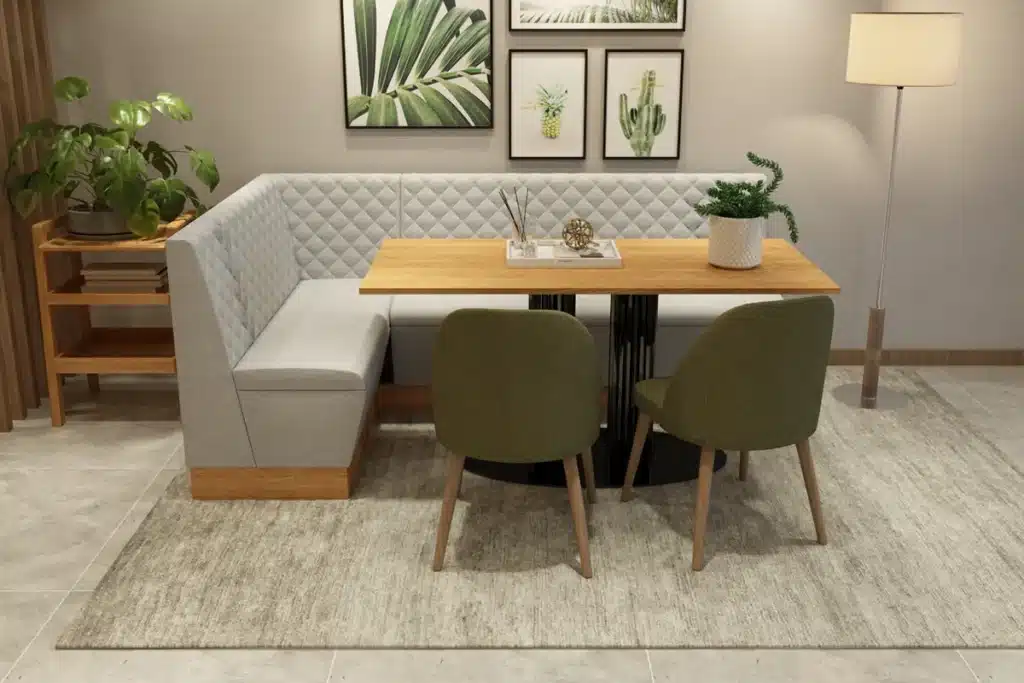
Haven quilted back corner booth seating installed in a modern dining room with table and accessories.

The Versatility of L-Shaped Banquettes

The Adaptable L-Shape uses L-shaped banquette seating to wrap around corners, structural elements or the edge of a zone. It’s one of the most versatile layouts because it can serve small tables placed along each leg of the “L”, or be combined with a single larger table for group dining.

Strategic Advantages: Efficient Corner Utilisation and Group Adaptability

L-shaped seating is brilliant for corners that would otherwise be hard to furnish. Instead of forcing in separate tables and chairs, you create one generous, continuous seat that can work for couples at quieter times and be joined together for larger parties at peak periods.


It’s also a strong option when you want boothesque comfort but a slightly more open feel than fully enclosed alcoves.

Ideal Restaurant Concepts: Cafés, Casual Dining, Pubs, Small Restaurants

The Adaptable L-Shape is ideal for:

  • Cafés needing flexible corner seating
  • Casual dining venues and pubs
  • Smaller restaurants where every square metre matters

For more on getting the most from tight footprints, see our banquette seating for small spaces guide: The Ultimate Guide to Banquette Seating for Small Spaces

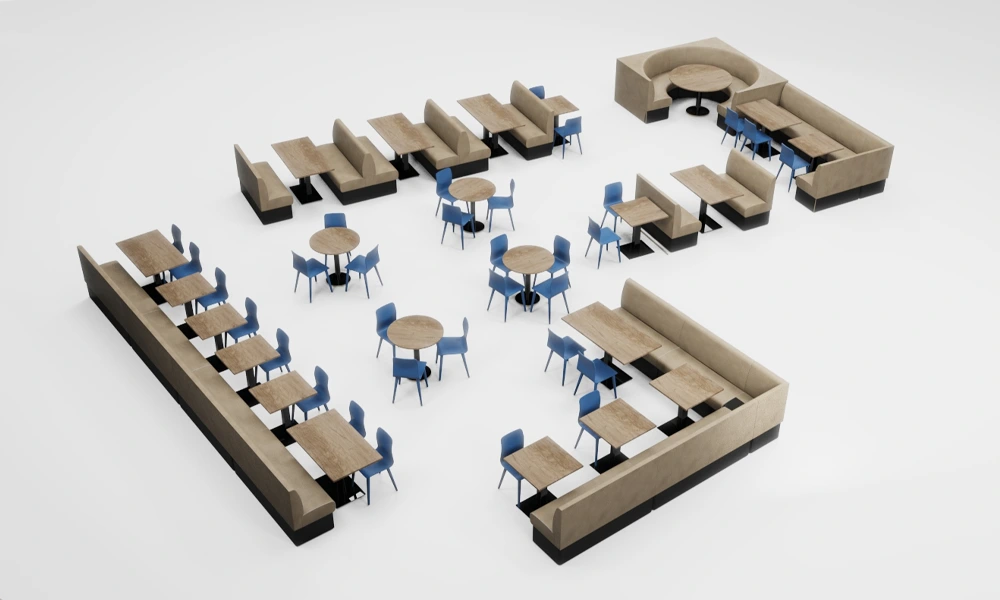
A large restaurant floor plan in 3D full of tables and chairs and booth seating laid out in various formations, with corner banquettes, straight runs and U shape sets

Design Considerations for L-Shaped Layouts

The main interior design challenge with L-shaped seating is making sure tables are sized and positioned so guests can get in and out comfortably, especially in the inside corner. Durable finishes on the outer edges, where traffic is highest, will keep everything looking fresh. Matching table tops and table bases across your straight runs, curves and L-shapes helps keep the whole room feeling coherent:

Key Considerations for Implementing Your Booth Seating Strategy

The Importance of Professional Restaurant Design Plans

Whatever layouts you choose, a clear plan is essential. That might be a full drawing package from an interior designer or a carefully measured sketch shared with our team. The point is to ensure every booth, table and chair has been thought about in relation to aisles, doors, fire exits and service routes before you go into production.

Measuring and Planning for Optimal Seating Plans

Before ordering restaurant booths:

  • Measure your space accurately, including alcoves, pillars and radiators
  • Factor in required aisle widths and fire escape routes
  • Consider future-proofing – can your layout adapt to different trading patterns?
  • If you’re unsure, collaborate with an interior designer or seating specialist to optimise your booth layout before committing to production

Material Selection and Durability (Upholstery, Wood, Fabric)

Choosing the right materials is crucial for long-term performance:

  • Contract-grade vinyls and fabrics for heavy use
  • Timber and board components suitable for commercial environments
  • Finishes that complement your brand and are easy to clean

Browse our cover choices for upholstery inspiration.

Customisation vs. Standard Solutions (Custom Banquette Seating, Bespoke Solutions)

Off-the-shelf units can work in some spaces, but custom banquette seating often delivers:

  • Better space utilisation & seating plans
  • More coherent restaurant interior design
  • Stronger brand alignment

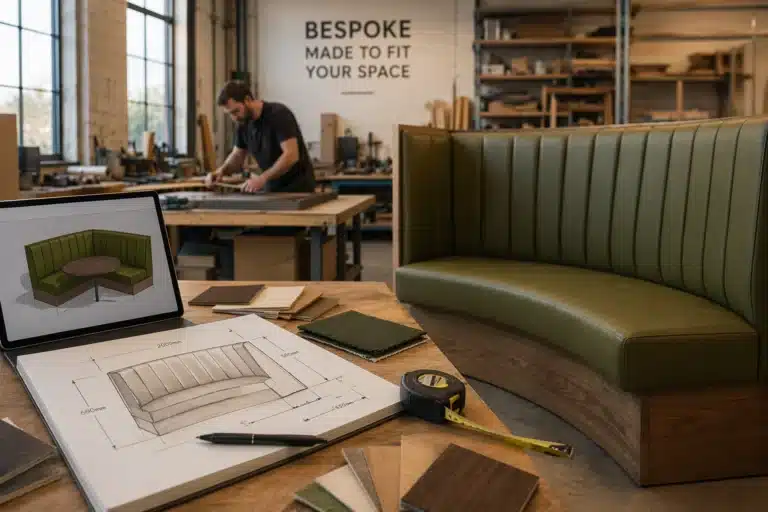
As a UK manufacturer, HCF specialises in bespoke booth and banquette seating – tailoring dimensions, shapes, and finishes to your concept and floor plan.

Maintenance and Longevity (Cleaning, Repair, Reupholstery)

Good booth seating should be an asset for years, not months. Plan for:

  • Easy access for cleaning around and under seating
  • Robust materials that withstand regular wiping and sanitising
  • Future reupholstery options to refresh your look without replacing frames

Budgeting for Quality Booth Seating and Installation

Finally, treat your seating as an investment, not simply a cost. Quality commercial booth seating:

  • Enhances customer experience
  • Supports your brand positioning
  • Reduces long-term replacement and repair costs


Working with HCF means you can source booths, banquettes, tables, table tops, table bases, chairs and stools together, simplifying procurement and ensuring everything works as a coherent whole.

Long run of blue button back banquette seating along a restaurant wall

Conclusion: Crafting Memorable Dining Experiences with Strategic Booth Layouts

Recap of the Power of Thoughtful Booth Design

Booth seating isn’t just an interior design style choice; it’s a strategic tool. Whether you’re creating intimate alcoves, efficient linear runs, social curved booths, flexible islands or versatile L-shaped banquettes, your seating plan shapes how guests feel, how staff work and how your brand lives in the real world.

The Lasting Impact on Customer Satisfaction and Brand Identity

Well-planned banquette seating, round booth seating and corner booth seating doesn’t just look good – it supports:

  • Higher guest satisfaction
  • Stronger brand recognition
  • A more profitable, efficient operation

Every venue is different. The right mix of layouts, materials and finishes will depend on your concept, your building and your guests.

For more ideas and inspiration, explore our blog.

Your Restaurant’s Unique Seating Story Begins Here

At HCF Contract Furniture, we’re here to help you turn your floor plan into a fully resolved seating strategy – from booth and banquette seating to matching tables, table tops, table bases, chairs and stools.

Get in touch to discuss your project and seating plans, and we’ll help you create seating that makes your new restaurant both beautiful and brilliantly functional

See Our Other Blog Posts

Banquette seating in a dimly lit restaurant interior, live oak wood walls and chairs around the room
Read More
Large Nook Acoustic Pods in an office space, brightly lit room and internal lights light up the interior of the meeting pods
Read More
A stack of fabrics in patterned designs on a table
Read More
author avatar
HCF Editorial Team Editorial Team
The HCF Contract Furniture Editorial Team brings together decades of experience designing and manufacturing UK-made contract furniture for restaurants, bars, pubs, hotels and hospitality venues. All content is written and reviewed by our in-house team using real manufacturing knowledge, project experience and industry standards, including Crib 5 compliance and contract-grade specifications.

What are you looking for?